Ghee for PCOS: Good or Bad? What Desi Ghee Really Does to Your Body
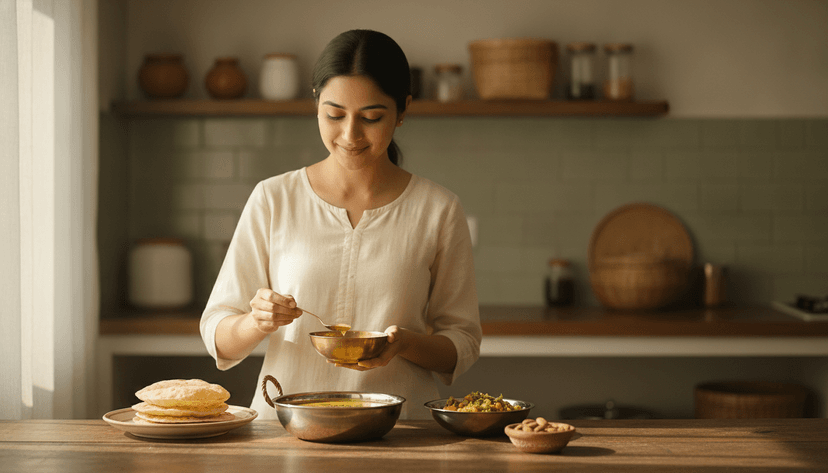
Ghee is the first thing to go once you're told to lose weight for PCOS, isn't it? The roti comes to you dry, the dal has no tadka, and someone at home reminds you that fat makes you fat. So if you are searching for ghee for PCOS, you are probably expecting a firm no.
Yes, the worry has some basis. Ghee is pure fat, it carries a lot of calories in a small spoon, and PCOS (renamed PMOS in 2026) often comes with weight gain and a changed cholesterol report. But neither the research nor Ayurveda asks you to throw the ghee dabba out. How much you use, what it replaces on your plate and what your own reports say matter far more than the ghee itself.
Why ghee got such a bad name
For years ghee was blamed for heart disease in India because it is rich in saturated fat and cholesterol. Many families moved to refined oils and vanaspati, thinking they were doing the healthy thing.
A 2010 review in the journal Ayu went back over the evidence. It pointed out that vanaspati, the so-called vegetable ghee, contains 40% trans fatty acids, and that the rise in heart disease among Indians also follows stress, insulin resistance and changing food habits. Its authors wrote that the data did not support a conclusion of harm from moderate ghee intake in the general population. Much of what they reviewed came from animal studies, so this is not the last word. Still, it tells you the old story of ghee as the villain was far too simple, and that vanaspati deserved most of the blame.
Is ghee good for PCOS? What the research says
Nobody has run a trial of ghee alone in women with PCOS. What we have instead are studies on what women with PCOS eat, studies on their cholesterol, and a few small studies of ghee in Indian adults.
A 2022 meta-analysis pooled 54 studies covering 39,471 women and compared the diets of women with and without PCOS. Total fat intake came out about the same in both groups. Where they differed was diet quality: most of the studies found that women with PCOS ate less from the major food groups, like grains, fruits, vegetables, nuts and seeds. So for most of you, too much fat is not the main problem in PCOS. Too little of the protective foods usually is.
PCOS does change your lipid profile, though. A 2011 meta-analysis found that women with PCOS had triglycerides about 26 mg/dL higher and LDL cholesterol about 12 mg/dL higher than women without PCOS. The authors advised that every woman with PCOS be screened for cholesterol problems. This is why the amount of ghee deserves some thought. Fear of fat doesn't come into it.
Underneath all of this sits insulin, which we explain in our post on PCOS and insulin resistance.
How Ayurveda sees ghee
In Ayurveda, ghee (ghrita) is one of the most respected foods in the kitchen. It is said to kindle agni (your digestive fire) without making it sharp or burning, and to carry the goodness of herbs deeper into the dhatus (body tissues). That is why so many classical Ayurvedic medicines are prepared as medicated ghee.
But Ayurveda never says the more, the better. PCOS is usually read as a Kapha and Vata imbalance, with ama (undigested residue) blocking the channels. If your body runs heavy, slow and Kapha-type, a lot of ghee only adds to that heaviness. If you run dry, anxious and Vata-type, with irregular periods and constipation, a little ghee often helps. Our guide to Ayurvedic PCOS typing walks through these patterns.
One small study from Pune gave rising amounts of cow ghee to 29 volunteers as part of snehapana, a supervised Panchakarma preparation. Their triglycerides came down and every one of them lost some waist. But these were healthy volunteers, the ghee was followed by a cleansing therapy, and an Ayurvedic doctor watched over every day of it. Please don't try this at home.
Ghee vs refined oils
In an Indian kitchen, ghee has one big practical advantage: a little gives a lot of flavour, so a teaspoon on dal satisfies you in a way a ladle of refined oil in the sabzi never does.
Your body still needs unsaturated fats from mustard oil, groundnut oil, nuts and seeds. So for most women with PCOS, the best plan is a mix of fats rather than one. Here is a simple way to split it:
- Use ghee for tadka, on a hot phulka or as a spoon on dal.
- Cook everyday sabzi in mustard or groundnut oil.
- Get the rest of your fat from a handful of nuts and seeds.
- Keep vanaspati and oil reused from frying out of your kitchen.
How much ghee is sensible with PCOS
A teaspoon with a meal is a fair place to start for most women. On a day with pakoras or mithai, leave it out. And if you are trying to lose weight, count the ghee as part of your fat for the day, not as an extra on top.
When you have it matters too. Ayurveda says agni is strongest at midday, so ghee with a warm lunch sits better than ghee with a late dinner. Have it with dal, sabzi and whole grains rather than on a plain white paratha. Our Ayurvedic dietary guidelines for PCOS show you how to build the rest of the plate.
When to go easy on ghee
Ghee doesn't suit everyone in the same amount. Be more careful if your reports show high triglycerides or high LDL cholesterol, or if you are trying to lose weight and the scale has not moved in weeks. The same goes if you have fatty liver, gallstones or acidity after rich meals. And if you feel heavy, sleepy and bloated after eating, Ayurveda reads that as weak agni with Kapha excess.
In any of these cases, cut back rather than cut it out, and get a lipid profile done so you know where you actually stand.
When to see a doctor
Changing how much ghee you eat is safe for most women. But see a doctor if your periods have been missing for more than three months, if you bleed very heavily, or if you gain weight suddenly. Go sooner if your lipid report shows high triglycerides or LDL, if you get chest pain or breathlessness when you exert yourself, or if you have signs of high blood sugar like constant thirst and passing urine often.
If you are pregnant, breastfeeding or taking medicines for cholesterol, diabetes or thyroid, check with your doctor before you try medicated ghee or any herbal preparation. And never stop or change a prescribed medicine on your own.
Small changes you can start this week
- Measure one teaspoon of ghee at lunch instead of pouring it straight from the jar.
- Throw out the vanaspati and stop reusing frying oil.
- Add one more bowl of sabzi and a small handful of nuts to your day.
- Get a fasting lipid profile if you haven't had one this year.
And here is the part most people miss. The fat that research has most clearly linked to harm in Indian kitchens is the trans fat in vanaspati, not the ghee your nani cooked with. So you don't need to give up ghee. You need to measure it, move it to lunch and keep an eye on your reports.
Get a plan built for you
An article can explain what usually happens and why. It can't read your reports. To know whether your symptoms come from PCOS, your thyroid, your weight, stress or something else, a doctor has to look at your whole history.
A Qura consultation is a video call with a BAMS Ayurvedic doctor. She goes through your reports with you and builds a 90-day plan that covers your diet, Ayurvedic medicine and regular follow-ups. We won't tell you PCOS will simply go away, because no honest doctor can promise that. What we can do is find what is actually driving your symptoms and work on that.
See how the 3-month PMOS (PCOS) program works, or book your consultation.
This article is for general information and can't replace advice from your own doctor. Please don't start or stop any medicine, herb or supplement without talking to a qualified doctor first, especially if you are pregnant, breastfeeding or already on medication.
Frequently asked questions
Is ghee good for PCOS weight loss?
Ghee won't make you lose weight, but a small amount doesn't have to stop you either. If weight loss is your goal, count ghee as part of your daily fat and keep it to about a teaspoon with a meal. Cut back further if your weight has stalled or your triglycerides are high.
Is cow ghee better than buffalo ghee for PCOD?
Ayurveda generally prefers cow ghee because it is considered lighter and easier to digest, while buffalo ghee is heavier. There is very little research comparing the two in PCOS, so how much you use matters more than which one you buy.
Can I have ghee on an empty stomach for PCOS?
Some families take ghee first thing in the morning on traditional advice, but it doesn't suit everyone. With high triglycerides, acidity or weak digestion it can sit heavy. Talk to your doctor or an Ayurvedic practitioner before starting any ghee routine, especially if you are pregnant, breastfeeding or on medicines.
Should I stop ghee if my cholesterol is high?
You may not need to stop completely, but you should cut back and talk to your doctor. Women with PCOS are more likely to have high triglycerides and LDL, so let your lipid profile guide how much ghee is right for you.
References
- Sharma H, Zhang X, Dwivedi C. The effect of ghee (clarified butter) on serum lipid levels and microsomal lipid peroxidation. Ayu. 2010;31(2):134-40.
- Kazemi M, Kim JY, Wan C, et al. Comparison of dietary and physical activity behaviors in women with and without polycystic ovary syndrome: a systematic review and meta-analysis of 39 471 women. Hum Reprod Update. 2022;28(6):910-955.
- Wild RA, Rizzo M, Clifton S, Carmina E. Lipid levels in polycystic ovary syndrome: systematic review and meta-analysis. Fertil Steril. 2011;95(3):1073-9.
- Mulay MS. Short term escalating administration of large amount of sneha does not increase blood lipids. J Ayurveda Integr Med. 2021;12(3):535-539.
Ready to Start Your Journey?
Discover how personalized Ayurvedic guidance can support your path to hormonal balance and wellness.
Consultation cost - Free
Start Your 90-Day TransformationStill have a question? Message our care team on WhatsApp and we'll help.
Chat with usRelated Articles
Rice and PCOS: Can You Still Eat Chawal? An Honest Indian Answer
Told to give up rice after your PCOS diagnosis? You probably don't have to. Here is how portion, pairing, cooled rice and lunchtime eating change what rice does to your blood sugar.
The 7-Day Indian PCOS Diet Plan: A Doctor-Designed Veg and Non-Veg Weekly Chart
A full 7-day Indian PCOS diet plan from Qura's BAMS doctors: a vegetarian chart for the whole week, a non-veg swap for every meal, honest answers on rice, ghee and dairy, and a free printable PDF.
Ayurvedic Treatment for PCOS Facial Hair (Hirsutism): An Honest Guide
PCOS facial hair, or hirsutism, comes from excess androgens, not from oily skin or bad habits. Here is what Ayurveda can honestly do about it, and what it cannot.